
Operator callout: Treat "open source" as the first question in the ownership review, not the final answer.
Is there an open-source AI agent platform?
Yes. The label covers products with different scopes, so compare each candidate against the same fields. The table reports only what each allowed first-party page or repository states. A missing statement stays missing. This article has not tested the candidates and does not rank them.
| Candidate | How its source describes the scope | Concrete capabilities named by the source | License stated by the source | Runtime, hosting, and deployment stated by the source |
|---|---|---|---|---|
| CrewAI | Open-source multi-agent platform (CrewAI) | Internet search, website interaction, vector-database queries, code execution, MCP, custom MCP servers, and E2B and Daytona sandbox tools (CrewAI) | not established by the cited page (CrewAI) | Captures runtime state at every step through checkpointing and supports native async/await execution; hosting is not established by the cited page (CrewAI) |
| VoltAgent | End-to-end AI Agent Engineering Platform with an open-source TypeScript framework and VoltOps Console (VoltAgent repository) | Memory, RAG, guardrails, tools, MCP, voice, workflows, and model-provider connections (VoltAgent repository) | MIT (VoltAgent repository) | A core runtime; VoltOps Console is labeled cloud and self-hosted and names deployment among its capabilities (VoltAgent repository) |
| LangChain | Open-source framework with a pre-built agent architecture and integrations for models and tools (LangChain) | Model, tool, and database swapping; more than 1,000 integrations (LangChain) | MIT (LangChain) | A LangGraph durable runtime with persistence, rewind, checkpointing, and human-in-the-loop support; LangSmith is described as its observability, evaluation, and deployment platform, and the page says it can deploy in one click; hosting is not established by the cited page (LangChain) |
Before you accept the platform label, answer these questions:
- Which repository contains the code under review?
- Which license does that repository state?
- Does the code cover model access, tools, orchestration, data, operations, or a subset?
- Which required components remain outside the repository?
- Who integrates, runs, updates, and recovers the resulting system?
- What evidence shows that another qualified operator can take over?
GitHub helps with discovery. Its overview of open-source AI projects spans MCP and multi-agent systems, which shows how broad this category has become (GitHub Blog). A listing or repository still needs an operating review.
What is the best open-source AI platform?
The supplied evidence does not support a universal winner. Choose the candidate that meets your written requirements with an ownership boundary you accept. The comparison above keeps the candidates on the same evidence fields. A single ranking across different scopes would hide the decision you need to make.
Use one requirements sheet for every candidate. Record the following fields:
- The work the agent must complete.
- The approved model connection and its owner.
- The business tools and permissions the agent may use.
- The location of workflow definitions and working data.
- The person responsible for updates, observation, and recovery.
- The assets that must transfer to a replacement operator.
Then reject any candidate with an unresolved requirement. Do not award points for a feature that your use case does not need. Do not infer license terms from a marketing label. Read the license stated by the repository under review.
Shortlist callout: Compare requirements, not the length of each project's feature list.
What is the best AI platform for agents?
Choose the operating route before you choose the software. A firm can build around open-source code, ask an integrator to assemble components, or buy support for a cockpit that the firm controls. None of these routes is a universal first choice. The table compares the responsibility boundary and does not rank a named framework.
| Route | What the firm chooses to own | Evidence to require | Decision signal |
|---|---|---|---|
| Build around open-source code | Platform engineering and the resulting configuration | Repository, stated license, configuration inventory, data locations, and recovery record | Choose when platform engineering is an internal function |
| Assemble with an integrator | Requirements, accepted assets, and operating authority | Component map, permission inventory, handoff material, and portability result | Choose when a qualified integrator owns the integration work |
| Buy supported ownership | The agreed cockpit, data, approvals, and exit assets | Ownership boundary, support responsibilities, evidence pack, and portability result | Choose when the firm wants support without making platform engineering its main job |
AI Jungle OS is positioned in the supported-ownership route. It is a done-with-you sovereign AI cockpit for boutique consulting firms, on a private box that stays theirs. That is product positioning, not a test result about the frameworks named in this article. See the AI Jungle OS cockpit.
For the deployment decision, use the AI agent platform boundary guide. The AI hosting guide separates the model endpoint, runtime, state, tools, and control plane. If cost affects your route, use the current pricing page instead of a copied price.
Which parts of an open-source agent stack must you own?
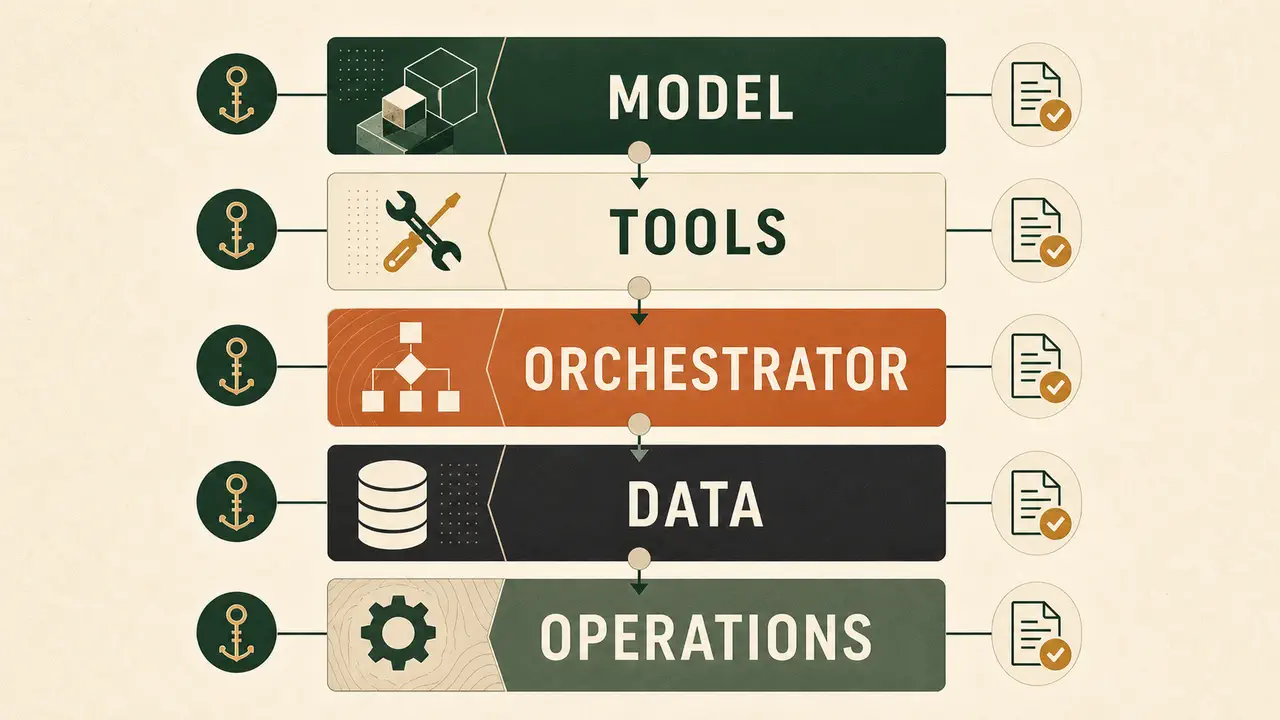
Code ownership is clear only when each connected layer has an owner, evidence, and an exit question. This review table is a buyer's worksheet. It does not claim that any named framework satisfies a row.
| Layer | Requirement to record | Evidence to request | Exit question |
|---|---|---|---|
| Model | Approved model access and its controller | Configuration and access inventory | Can another approved model connection be configured without redesigning the workflow? |
| Tools | Business systems and allowed actions | Tool and permission inventory | Can each connection be removed or replaced? |
| Orchestrator | Location of agent roles and workflows | Source location and workflow map | Can a qualified replacement operator run the definitions? |
| Data | Location of business context and outputs | Data-location and export inventory | Can the firm retrieve the agreed working context in a usable form? |
| Operations | Responsibility for observation, updates, and recovery | Runbook and named responsibilities | Can another qualified operator restore the agreed scope? |
Use the candidate comparison above to fill the component fields. Use the ownership worksheet for the operating boundary. A framework's feature list does not assign responsibility for your firm's connected system.
For adjacent boundaries, compare the private AI guide with the on-premise AI platform guide. Use the AI Jungle OS security page for the product's stated security boundary.
Can you run AI agents for free?
The candidate comparison records only the license evidence stated by each cited source. It does not establish a no-cost operated agent system. The ownership worksheet still needs separate cost records for model calls, hosting, connected services, integration work, maintenance, and support.
Separate the cost questions before choosing a platform:
- What does the repository license permit? Use the license in the repository under review.
- What model or API dependencies does the chosen setup use?
- Where will the runtime and working data live?
- Who will integrate, observe, update, and recover the system?
- Which connected services have their own commercial terms?
- Which support costs apply? For AI Jungle OS, check the pricing page.
"Free" is therefore a component claim unless the full operating scope is defined. Keep code cost and system cost in separate rows of the decision sheet.
Can I create my own AI agent for free?
The comparison shows which building blocks the cited sources name. It does not prove that your complete agent will have no cost.
Start with one agent role and write its accepted scope. Name the model connection, tools, workflow definition, required data, operator, and recovery material. Then evaluate each dependency on its own terms. This process tests the operating boundary. It is not evidence that a named framework has been tested here.
What are the 7 types of AI agents?
The supplied evidence does not support one canonical list of seven AI-agent types, so this guide does not invent one. The candidate comparison records scope and capabilities, not a shared seven-part taxonomy.
For a buying decision, classify the requirement instead. Ask whether you need a single agent or coordinated agents, which work they perform, which tools they can use, and who operates the system. That gives you selection criteria without presenting a disputed taxonomy as fact.
How should you test portability?
A useful portability test asks a second qualified operator to reproduce the agreed scope from the recorded assets on the firm-controlled box. This is an acceptance method proposed by this guide. It is not a claim about the tested portability of CrewAI, VoltAgent, LangChain, or any other framework.
Use a narrow test:
- Select one representative agent role.
- Record its model connection, tools, workflow definition, and required data.
- Place the agreed assets in a clean location controlled by the firm.
- Give the recorded material and stated access to a second qualified operator.
- Ask that operator to run the agreed task without undocumented knowledge from the first operator.
- Record missing assets, hidden dependencies, and unresolved decisions.
- Repeat the acceptance test after the gaps are fixed.
Portability callout: Test a real workflow before you treat portability as an architectural property.
The evidence pack should identify source locations, configuration locations, data locations, access requirements, operator duties, and the reproduction result. Screenshots alone do not contain the assets needed for another operator to run the system.
What does source access not solve?
Readable code is not the same deliverable as an operated, owned cockpit. Source access does not select approved models, grant tool permissions, locate business data, assign operational responsibility, or prove recovery. These are separate requirements and integration decisions.
Keep these records distinct:
- The repository record names the code location and the project's stated license.
- The configuration record names the agent definitions, connections, and settings created for the firm.
- The data record names the business context and outputs used by the agents.
- The operations record names who observes, updates, and recovers the system.
- The handoff record names the assets and access a replacement operator receives.
Once those records exist, the platform discussion gets concrete. You can compare candidates without pretending that a public repository answers every ownership question.
Written by Tileo, who operates a portfolio of internet businesses on this same cockpit.