
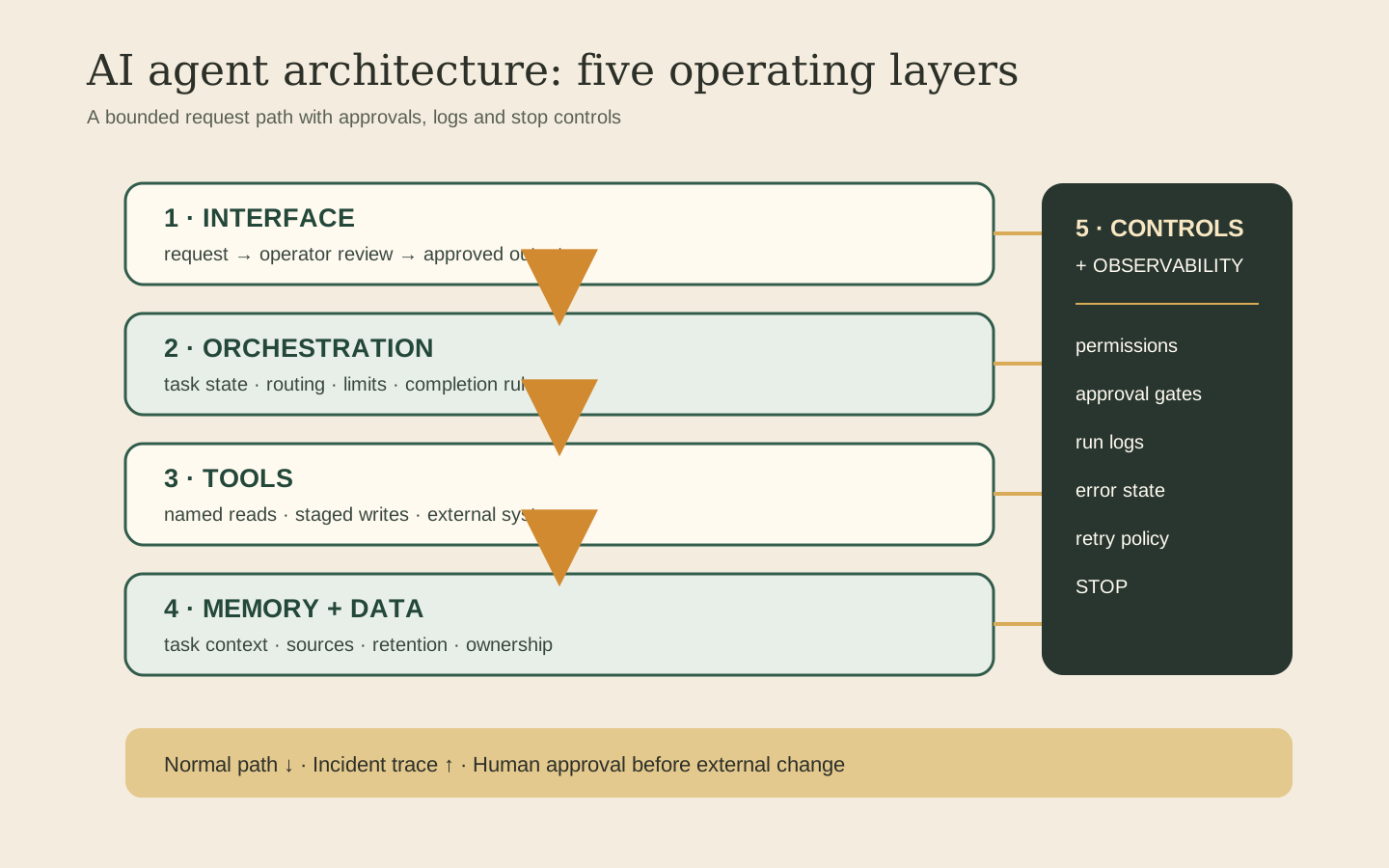
AI agent architecture is the system design that connects an agent's input, decisions, tools, data, and controls (IBM, Atlan). This guide uses a five-layer operator diagram: interface, orchestration, tools, memory and data, and controls and observability. It maps request flow, permission and data boundaries, approval points, logs, failure paths, and stop controls for an owner-led firm. Use it to trace both a normal run and a failed one before the system touches client work. The goal is a workflow an operator can inspect, deny, retry, or stop, not a larger roster of agents.
What is AI agent architecture?
AI agent architecture is the design of the system around an agent. IBM defines agentic architecture as the structure and design of agentic AI frameworks. Its account connects reasoning with perception, memory, tools, and action (IBM). Atlan describes a perceive, reason, act loop supported by a reasoning core, tool integrations, and memory (Atlan).
That loop is necessary, but it is not the full operating picture. A diagram that ends at “model, memory, tools” leaves practical questions open:
- Who can submit a task?
- Which system is allowed to change?
- What happens when a tool fails?
- Which records become context for the next run?
- Who can approve, inspect, pause, or stop the work?
Architecture answers those questions before deployment. It turns an agent from a clever prompt into a bounded operating system for one workflow. The AI agent workflow control map carries that boundary into the operating path.
For a boutique consulting firm, begin with a real job such as preparing a client follow-up. The input could be an operator request. The output could be a draft waiting for review. Between them, the system may need client context and an email tool. The diagram must state where each part runs and which boundary each action crosses. The private AI guide makes the same point about deployment: “private” is useful only when records, access, permissions, and external connections have named owners.
Which components belong in an agent system?
Use five layers. This is an operator view, not a claim that every framework uses the same labels. IBM, FME, Atlan, and PuppyGraph all describe core elements such as a reasoning component, memory, external tools, and an input or perception path (IBM, FME, Atlan, PuppyGraph). The fifth layer makes runtime control visible.
| Layer | What belongs here | Private-box consulting example | Boundary question |
|---|---|---|---|
| Interface | Task input, operator view, review state, final output | A consultant requests a client follow-up and sees a draft | Who may submit, review, and close the task? |
| Orchestration | Instructions, task state, routing, iteration limits, completion rules | One agent gathers context, drafts, then sends the work to review | What exact event starts, advances, and ends the run? |
| Tools | Named functions and connectors that read or change another system | Read an approved client record; stage an email draft | Which action is read-only, and which action can change external state? |
| Memory and data | Current task context, retained records, source references, retrieval rules | The client brief and the operator's approved notes stay attached to the client instance | What is stored, where, for how long, and under whose ownership? |
| Controls and observability | Permissions, approvals, logs, error state, escalation, stop controls | A public send waits for an owner decision; the run records tool results and failures | Can an operator explain, deny, retry, or stop the action? |
Read the table from top to bottom for the normal path. Read it from bottom to top during an incident. The controls layer should tell the operator what happened. The data layer should identify the context used. The tool layer should show which external call failed. The orchestration layer should show whether the run may retry. The interface should present the next human decision.
This framing also prevents a common design mistake: treating the model as the whole system. FME separates the language model, contextual memory, external functions or sub-agents, and routing (FME). The surrounding application owns the workflow state and tool execution. Your architecture document should do the same.
When is one agent enough?
Use the least complex design that meets the workflow requirement. Microsoft places direct model calls, a single agent with tools, and multi-agent orchestration on a complexity spectrum. It recommends a single agent with tools when one agent can handle varied requests inside one domain. Multi-agent orchestration adds coordination overhead and failure modes (Microsoft Azure Architecture Center).
A single agent is enough when all of these statements hold:
- The work belongs to one bounded business domain.
- One instruction set can describe the goal and stop condition.
- The allowed tools fit one permission profile.
- The same review gate can cover the resulting actions.
- One operator can understand the run from its task record.
Add another agent only when the split creates a real boundary. A separate reviewer can make sense when creation and checking use different criteria. A specialist can make sense when it needs a separate knowledge source or a separate permission set. Parallel agents can make sense when independent work can run without conflicting changes to shared state. Microsoft documents sequential, concurrent, group chat, handoff, and adaptive orchestration as patterns with different coordination requirements (Microsoft Azure Architecture Center). They are options, not a maturity ladder.
Do not add agents to make the diagram look advanced. Each added participant creates another handoff, context boundary, and failure point (Microsoft Azure Architecture Center). If deterministic application code can route a known task, use that route. FME distinguishes predefined workflows from agent routing and notes that rule-based routing can call a function from application rules (FME).
For a deeper pattern comparison, read the AI agent orchestration guide. For the buyer-side scope and handoff checklist, see AI automation services.
Where should data and credentials live?
Put business records inside a named data boundary. Give each tool only the access its job requires. Galileo identifies tool misuse, memory poisoning, and contaminated retrieval data as agent risks, and recommends extending access controls across tools, memory, and external data validation (Galileo).
Data and credentials are related, but they are not the same layer. Data supplies context. A credential grants authority. An agent may be allowed to read a client brief without being allowed to send an email. It may be allowed to stage a draft without being allowed to publish it. Keep those permissions separate in the diagram (Galileo).
For each data source, write down:
- system of record and owner;
- read, write, or delete permission;
- context passed to the model or tool;
- retained output and deletion path;
- provider boundary crossed by the request.
The AI Jungle OS BYOK guide states that a model key under the client's control can be viewed, rotated, and revoked by that client. It also warns that BYOK alone does not settle hosting, logs, connected apps, backups, or administrator access.
AI Jungle OS describes its private box as a dedicated operating instance, with business records attached to that client instance and connected providers governed by their own terms (product page). That is one deployment boundary. It is not proof that every dependency stays on the box. Map every model API and connected business tool separately.
What controls make an agent operable?
An operable agent has a visible state, a limited action surface, and a human path for exceptions (Galileo). Galileo treats runtime visibility, policy enforcement, and intervention as parts of an agent control plane (Galileo). Microsoft recommends iteration limits for a single agent with tools and defines escalation or fallback behavior when an orchestration cannot complete (Microsoft Azure Architecture Center).
Build these controls into the workflow record:
- Permission scope. List the exact tools and actions available to the run.
- Approval gate. Mark actions that wait for a named operator before external change.
- Iteration limit. Stop repeated tool calls or agent handoffs at a defined cap.
- Completion rule. State what evidence marks the task done.
- Failure state. Preserve the failed step, tool result, and last safe state.
- Escalation route. Name the person or queue that receives unresolved work.
- Action log. Record requests, approvals, tool calls, outcomes, and operator changes.
- Stop control. Give the operator a way to pause a task or remove access.
AI Jungle OS documents dedicated tenancy, scoped credentials, approval queues, and action logs on its security and operational controls page. The same page says those controls do not create a compliance certification and assigns business users, approvals, and risk decisions to the client. Product scope still needs to be checked against the selected engagement. This article does not claim that the cockpit implements every orchestration pattern described by Microsoft or every control discussed by Galileo.
Failure boundaries to draw before launch
- Bad input: The interface rejects a task that lacks its required client, source, or desired output.
- Missing context: The run stops instead of filling a client-data gap with a guess.
- Tool timeout: The orchestration records the timeout and follows a defined retry or escalation rule.
- Bad tool output: Validation prevents malformed or incomplete data from reaching the next step.
- Loop: The iteration cap stops repeated reasoning, calls, or handoffs.
- Conflicting writes: One owner or deterministic rule resolves changes to shared state before execution.
- Approval delay: The task remains waiting without treating silence as consent.
- Provider outage: The run keeps its last safe state and exposes the blocked dependency.
Implementation checklist
- [ ] Name one workflow, one owner, and one measurable completion rule.
- [ ] Draw the five layers and every external boundary crossed by a request.
- [ ] Start with a direct model call or one agent unless the workflow proves a need for coordination.
- [ ] Give each tool a written input, output, permission scope, and failure response.
- [ ] Separate business data from credentials.
- [ ] Decide which context is temporary and which record may persist.
- [ ] Put external changes behind the required approval gate.
- [ ] Set iteration, timeout, retry, and escalation behavior.
- [ ] Log tool calls, approvals, outcomes, and operator changes.
- [ ] Test every failure boundary with a denied, missing, delayed, or malformed input.
- [ ] Confirm the export, revocation, and shutdown path before live work.
FAQ about AI agent architecture
What is the simplest AI agent architecture?
For a bounded task, it can be one interface, one agent with a small tool set, a defined context store, and a control layer. Microsoft says a direct model call is enough for a single-step task that does not need agent logic or tools. Use an agent only when the work needs dynamic tool use or repeated decisions (Microsoft Azure Architecture Center).
Does an AI agent need long-term memory?
No. Memory should match the task. Atlan separates active session context from persistent knowledge retrieved across sessions (Atlan). If a workflow can finish from the current request and approved records, do not add persistent memory without a clear operating reason.
Is multi-agent architecture better than a single agent?
Not by default. Microsoft says multi-agent orchestration adds coordination overhead, latency, and failure modes. It fits work that crosses domains, needs distinct security boundaries, or benefits from parallel specialization (Microsoft Azure Architecture Center).
What should an AI agent architecture diagram show?
Show the user or event that starts the task, orchestration state, models, tools, data stores, credentials, external providers, approval points, logs, error paths, and stop controls. Label every read and every external change. The diagram should let an operator trace a normal run and a failed run.
How do you choose an agent architecture for a consulting firm?
Choose one client workflow and map its operational boundary. Keep the first design within one domain and one permission profile. Add tools only for named actions. Add another agent only for a distinct role or boundary. Then test approval, tool failure, revoked access, and shutdown before client work enters the system.
Written by Tileo, who operates a portfolio of internet businesses on this same cockpit.