
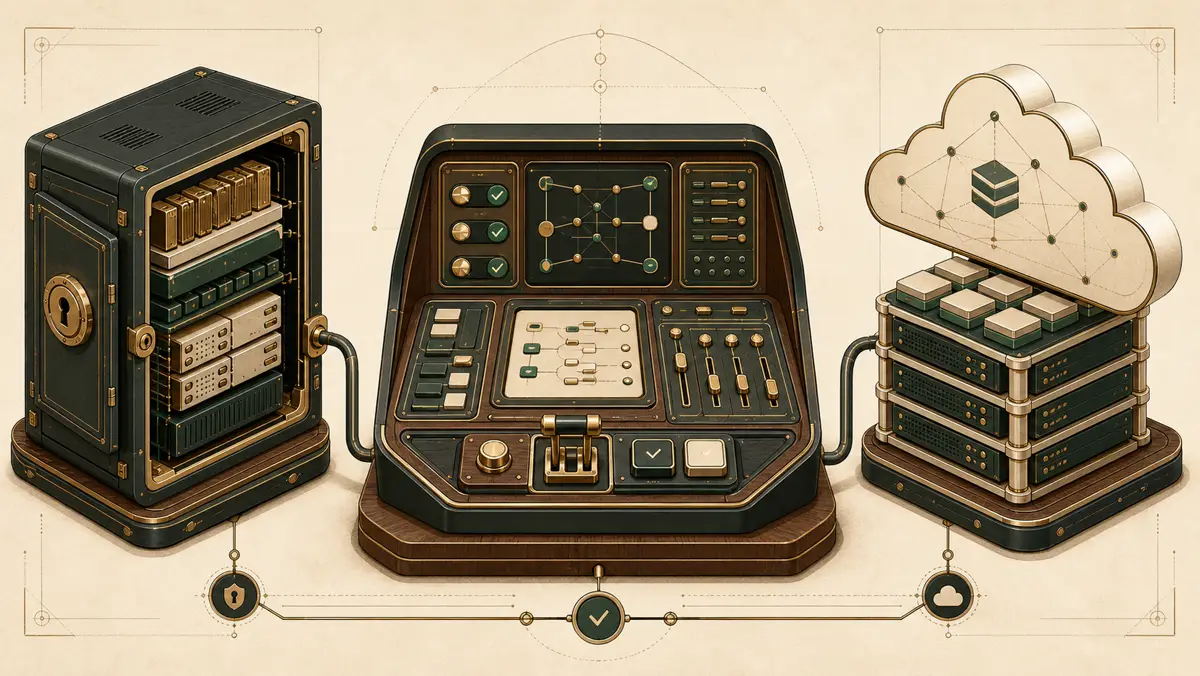
Can you run an AI agent locally?
Yes. A local AI agent can place its model, agent loop, memory, working documents, and interface on hardware controlled by the firm. These are separate choices because a local process can still use an external model or service.
Yes. An AI agent can run locally when its working loop runs on hardware controlled by the operator. It receives a goal, uses a model to decide what to do, and may call an allowed tool. The code around the model executes that tool and returns the result to the model. The freeCodeCamp technical guide describes this sequence and makes the control boundary explicit: the model requests a tool call, while the surrounding code runs the function. freeCodeCamp
A local agent places that working loop on hardware controlled by the operator. The model may also run there. So may memory, documents, and the interface used by staff. But those choices are separate. Calling the whole system “local” without naming the boundary can hide an outside dependency.
LocalAI documents agents that can reason, use tools, keep memory, and interact with external services while running as part of a local process. LocalAI
For an owner-led consulting firm, use a plain test: map where each part runs and where each request goes. If a local process sends a task to an external model or calls a web service, that connection belongs in the operating picture. LocalAI’s own agent documentation says agents can interact with external services and can be configured to use an external model provider. LocalAI
This creates three useful deployment labels:
Local model: Model inference happens on your hardware. Ollama says it does not see prompts or data when Ollama runs locally. Its cloud-hosted models are a different mode. Ollama
Local orchestration: The agent loop, tool permissions, state, and task routing run on your hardware. LocalAI documents locally running agents with tools, memory, knowledge collections, and connectors. LocalAI
Private-box deployment: The chosen local parts run on a box assigned to the firm rather than on an individual user’s laptop. This is an operating boundary, not a named software stack.
These labels can overlap. They should not be treated as synonyms. A useful decision record says which label applies to each workload and names any connection that crosses the box boundary.
Where do the model, runtime, and data live?
Start with the workload when assessing the self-hosted AI starter kit, not a product list. A local runtime can serve models. An agent layer can hold instructions and invoke tools. A knowledge layer can store working documents or retrieved text. LocalAI presents model runtime and agent functions within one control plane, but that project is an example of what can be local, not a claim about the components used by AI Jungle OS. LocalAI
The model is only one part. freeCodeCamp’s sample local agent includes a local model runtime, Python code, tool calling, and short-term conversation memory. Its guide also explains that a base model does not execute the requested Python function itself. The surrounding application performs the call. freeCodeCamp
Use this boundary list during discovery:
Model inference: Decide whether prompts and generated output are processed on the box or by a hosted model. Ollama distinguishes local operation from its cloud-hosted model mode. Ollama
Agent orchestration: Decide where goals, tool requests, task state, and agent configuration are handled. LocalAI documents these capabilities inside its local agent platform. LocalAI
Memory and knowledge: Decide where conversation state and working documents live. The freeCodeCamp guide stores short-term conversation history for its sample agent, while LocalAI documents local knowledge-base storage choices. freeCodeCamp LocalAI
Tools and connectors: Record every file action, code action, API call, and external service available to the agent. LocalAI lists actions and external connectors as configurable agent capabilities. LocalAI
Operator interface: Decide where staff create agents, review activity, and monitor the service. LocalAI documents a web interface for creating, editing, chatting with, and monitoring agents. LocalAI
This map prevents a false binary between “cloud” and “local.” A firm may choose local orchestration with a hosted model. It may choose local inference for one workload and a hosted path for another. The private AI guide helps frame the boundary, while the BYOK guide covers a separate model-access choice.
If you want to see how that boundary is presented as an owner-operated cockpit, See the AI Jungle OS cockpit.
What hardware and maintenance decisions matter?
Hardware fit depends on the selected model, context, and request pattern. Ollama’s documentation says a larger context length increases the memory required to run a model. Its FAQ also says concurrent processing depends on available system memory or GPU memory, and requests may queue when memory is not available for another model. Ollama context documentation Ollama FAQ
That means “buy a box” is not yet a hardware brief. The firm needs a named workload and an acceptance test. A document task, a coding task, and an agent connected to business tools can place different demands on the system. Do not turn a project tutorial’s laptop into a universal recommendation. The freeCodeCamp author reports using a MacBook Pro with 32 GB of RAM for the tutorial and says a smaller model can be selected for a lower-memory machine. That is a tutorial setup, not a business benchmark. freeCodeCamp
Maintenance also remains visible. Ollama documents update steps, logs, model storage, server settings, request queues, and hardware support. Ollama LocalAI documents authentication, API keys, roles, and usage visibility for a team server. LocalAI
This compact matrix turns those documented variables into workload tests. It does not prescribe a stack or guarantee fit: LocalAI supports the agent, tool, memory, connector, and team-control examples; Ollama documents context, memory, concurrency, queues, logs, and server settings; and freeCodeCamp shows that application code, not the model, executes a requested tool call. LocalAI LocalAI Ollama context documentation Ollama FAQ freeCodeCamp
| Boutique-firm workload | Parts that can be local | Likely boundary-crossing dependency | Hardware variable to test | Operating duty | Concrete acceptance check |
|---|---|---|---|---|---|
| Internal document assistant | Model inference, orchestration, working documents, and memory | An external model endpoint or connector, if enabled | Selected model, context length, and available system or GPU memory | Own updates, document access, logs, and model storage | Run a representative document set; confirm the required answer is produced and inspect whether any request leaves the box |
| Tool-using back-office workflow | Agent loop, tool permissions, task state, memory, and optionally inference | The business API or external service called by an allowed tool | Selected model, context length, concurrent request pattern, and available memory | Own tool access, credentials, logs, queues, and updates | Complete one approved action with test data; confirm the expected system result and that an unapproved tool is unavailable |
| Shared staff assistant | Agent configuration, interface, knowledge store, orchestration, and optionally inference | An external model provider, connector, or network path exposed for staff access | Selected model, context length, concurrent staff requests, and available memory | Own authentication, roles, usage review, server settings, and updates | Test each staff role against its permitted agent, reject an unauthenticated request, and verify the activity is visible to the operator |
Use the following table before choosing a deployment path.
| Readiness question | Ready for a local or private-box path when | Pause and define first when |
|---|---|---|
| What task will the agent perform? | The workload and allowed tools are written down | “General AI help” is the only brief |
| What must stay on controlled hardware? | Each local component and outside connection is mapped | “Everything is local” has no boundary map |
| What model and context are required? | The team has a workload-based test | Hardware is being chosen from a tutorial setup |
| Who owns routine operation? | An owner is named for updates, logs, access, and server settings | Ownership ends after installation |
| How will the firm accept the result? | The task has observable acceptance checks | Success depends on an open-ended impression |
The table is a readiness tool. It is not a hardware sizing formula. A firm that cannot name the workload cannot test whether the selected box fits it. A firm that cannot name an operator has not assigned the maintenance work.
For the commercial decision, compare the ownership boundary in the private box versus SaaS guide. Review the current engagement path on pricing without assuming that a hardware choice settles the operating model.
Are local agents private by default?
No. A local process is not a complete privacy claim. You still need to inspect model mode, tool calls, connectors, network exposure, stored state, and operator access.
Ollama states that it does not see prompts or data when Ollama runs locally. The same FAQ says cloud-hosted models process prompts and responses to provide that service. It also documents a local-only setting that disables Ollama cloud features, plus settings that can expose the server on a network. Ollama
LocalAI describes agents that run locally and can interact with external services. It also documents per-agent settings that can point to an external model provider. LocalAI These examples show why “the agent is on our box” does not answer where every request travels.
Privacy review should follow the actual boundary:
Check model mode and endpoints. Record whether each model request stays on the box or reaches an external provider. Ollama distinguishes local use from cloud-hosted model use. Ollama
Check tools and connectors. A locally running agent may still call external services through its allowed actions. LocalAI documents API calls and external connectors as agent capabilities. LocalAI
Check network exposure. Ollama binds to a local address by default and documents how that address can be changed or exposed through a proxy. Ollama
Check stored state and access. LocalAI documents persisted agent state, knowledge-base storage, authentication, roles, and usage visibility. LocalAI LocalAI
Do not replace this review with a security guarantee. Treat local deployment as an architectural choice that makes some controls available to the operator. Then decide how those controls will be configured and checked. The security and governance guide provides the internal next step for that review.
What should a consulting firm buy: local, hybrid, or managed?
A managed SaaS is the simpler operating choice when the firm does not want to own the box and its runtime duties. That is a management decision, not a statement that one architecture fits every workload.
Choose the managed path when the desired outcome is clear but no one in the firm will own updates, logs, access, capacity decisions, or server settings. Choose a local or private-box path when the boundary itself matters and the firm accepts the named operating role. If the team wants control of model credentials while keeping a hosted service, review the BYOK guide as a distinct option.
The key question is not whether local agents are fashionable or technically possible. The question is whether the firm wants the responsibility that comes with the boundary. A local model can change where inference occurs. Local orchestration can change where agent state and tool policy live. A private box can change who controls the host. None of those choices assigns an operator by itself.
Use a short decision sequence:
- Name the workload and its acceptance checks.
- Map the model, orchestration, memory, tools, and outside connections.
- Assign the hardware and operating owner.
- Review privacy and network settings against the real configuration.
- Compare that ownership model with a managed service.
If the local boundary is part of the outcome and the owner is named, continue into a private-box assessment. If the operating duties have no owner, choose a managed path or narrow the local scope. The box versus SaaS guide can support that comparison.
Is a local model the same as a local agent?
No. A local model handles inference on local hardware. An agent also includes surrounding logic for goals, tool calls, state, and results. The model emits a structured tool request and the application code executes the function.
The freeCodeCamp guide documents that tool-calling sequence. freeCodeCamp
Does a private box remove maintenance work?
No. The operator still needs an owner for the runtime and host. That work includes updates, logs, storage, queues, hardware settings, team-server controls, and usage visibility.
Ollama documents the runtime and host duties. Ollama LocalAI documents the team-server controls and usage visibility. LocalAI
Do local agents avoid every external connection?
Not by default. Locally running agents can interact with external services and can be pointed to an external model provider. The deployment review must list the tools, connectors, and model endpoints actually enabled.
LocalAI documents both kinds of external connection. LocalAI
How should a boutique firm start the decision?
Start with one written workload, its allowed tools, and an acceptance test. Then map which parts run on controlled hardware and name the operator. The readiness table is a scoping aid, not a promise that a specific box or model fits an untested workload.
Ready to inspect the private-box path? See the AI Jungle OS cockpit.
Written by Tileo, who operates a portfolio of internet businesses on this same cockpit.