
JOURNAL BUYER GUIDE
Self-hosted AI is an ownership choice, not a single stack
Self-hosted AI can mean running a model on your own box, owning a workflow or agent cockpit, or still buying a managed service. For an owner-led firm, pick the path by who patches, who holds credentials, who watches failures, and what you can take with you on exit.
What does self hosted AI mean for an owner-led firm?
Qualix defines self host AI as running AI models, AI apps, or AI workflows on your own infrastructure instead of sending every request to a third-party cloud platform.1 Northflank describes self-hosting an AI model as running the AI on your own servers, with you responsible for downloading the model, setting it up, and managing the process.2 That is model self-hosting. A private box on this site is different: shared SaaS usually places many customers inside one vendor-operated application, while a private box creates a dedicated instance whose access and records can be inspected separately. The box is not automatically better at every task. Shared SaaS can be simpler to buy and maintain. The private-box trade is more operational control in exchange for clearer client responsibilities.
See what AI automation actually means before you compare platforms, or how the same ownership question plays out when the alternative is hiring an AI automation agency instead of self-hosting. For the privacy boundary next to this choice, read the private AI guide. For workload-level boundaries, use the local AI agents decision guide.
For a practical local, cloud, or hybrid workload worksheet, read the on-premise AI platform buyer’s decision sheet.
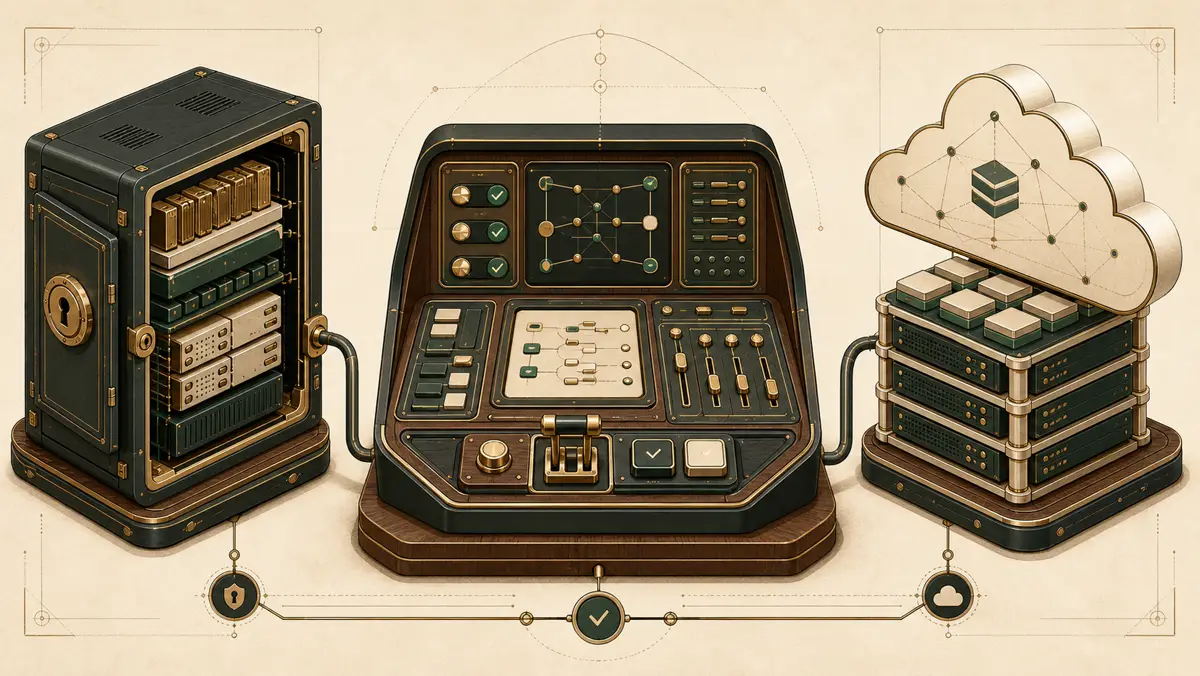
Three ways people say “self-hosted AI”
Budibase treats “self-hosted AI tool” as a broad label: any LLM-powered system or stack component you deploy on your own infrastructure instead of consuming as a cloud service.3 University of South Florida Libraries define self-hosting AI tools as running large language models and related systems on your own laptop, workstation, or secure server instead of relying on cloud services.4 Operators still collapse three different jobs under one phrase:
- Model self-hosting. You run inference where you choose. Northflank lists the model, an inference engine, and the hardware that powers them as the pieces you must supply.2
- Self-hosted workflow or agent cockpit. Qualix groups AI apps and AI workflows with models under the same self-host umbrella: the orchestration layer, approvals, and tool connections live on infrastructure you control.1
- Managed SaaS. The vendor operates the shared application. You buy access. Tenancy, patching, and failure response stay with the vendor unless the contract says otherwise.
Homelab write-ups often stop at chat UIs on a local GPU. A consulting firm usually needs the middle row: agents that touch client systems under named permissions, with an exit path. That is the private-box decision, not a laptop demo.
| Model self-hosting | Self-hosted workflow / agent cockpit | Managed SaaS | |
|---|---|---|---|
| What you mainly own | Model weights, inference runtime, and the machine that serves them2 | Orchestration, approvals, tool connections, and the dedicated instance boundary | An account inside a vendor-operated multi-tenant app |
| Who patches | You (or your infra partner) patch runtime, OS, and model updates | You (or your cockpit partner) patch the box, agents, and connected stack; split must be named | Vendor patches the shared application on its schedule |
| Who holds credentials | You hold host, model, and any gateway keys | You hold model keys (BYOK when used), app secrets, and admin access to the box | Vendor holds platform credentials; you hold login and any keys you paste into the product |
| Who watches failures | You watch GPU/host health, model process, and capacity | You watch workflow failures, approval queues, and integration errors; partner support only if contracted | Vendor watches platform uptime; you watch your own usage and business outcomes |
| Exit portability | Weights and prompts you control can move; custom wiring moves only if you documented it | Export and re-home agents, permissions, and records if the box was built for exit | Leave with whatever export the vendor exposes; rebuild workflows elsewhere |
Choose the box when data location, permissions, approvals, export, and exit matter more than instant self-service. Choose shared SaaS when speed of signup beats a dedicated tenancy boundary. Choose raw model self-hosting only when the firm will staff inference operations, not only prompt experiments.
Is it possible to self host AI?
Yes. Sources treat it as a practical deployment choice, not a research stunt. DeployHQ states that running AI models on your own infrastructure instead of calling cloud APIs is a path teams take when they want data to stay on their servers and to choose the model themselves.5 USF Libraries describe the same move as running LLMs and related systems on a laptop, workstation, or secure server.4 Tailscale’s local-stack write-up walks through an offline-capable lab with models and a chat UI on hardware you control.6
Possible does not mean free of work. Northflank is explicit that when you self-host, you manage the process yourself.2 That management duty covers download, setup, and day-to-day operation of the model stack.2 For a boutique firm, “possible” splits into:
- Local model lab. Useful for private drafts and experiments on a machine you control.4
- Production agent cockpit. Needs a dedicated instance, named admins, approval rules, and a support split. See the AI agent platform guide for SaaS versus self-hosted platform shape.
- Hybrid. Cockpit on your box, models still called via keys you hold. That is still self-hosted operations for the workflow layer, not full model isolation.
What is the best self-hosted AI?
There is no single best product. “Best” only means fit for the job you are willing to operate.
Qualix’s catalog mixes model runners, chat UIs, and workflow tools under one self-host list, and says the right setup depends on use case, model size, security requirements, and team skills.1 Budibase likewise frames self-hosting as a control choice for security-focused organizations, not a scoreboard of chat apps.3 Medium’s local-first stack post names runtimes such as Ollama, vLLM, llama.cpp, and LM Studio as common building blocks for developers who want models off third-party APIs.7 Those tools answer “how do I run a model.” They do not answer “who owns client workflows tomorrow.”
For an owner-led consulting firm, score candidates with operator questions:
- Does this give us a dedicated tenancy boundary, or only a local chat window?
- Who can approve irreversible actions against email, CRM, or billing?
- Can we export agents, permissions, and records without a vendor ticket?
- Will we staff patches and failure watch, or buy a done-with-you cockpit that still leaves operation with us?
If the answer is “we want the cockpit without building the stack from scratch,” start at the product page rather than a model leaderboard.
Is hosting your own AI worth it?
Worth it only when the operating trade matches the firm. An XDA operator essay argues local AI is not for everyone, and names privacy as the author’s primary reason for running workloads on their own servers, alongside leaving cloud subscription and token-limit friction.8 USF lists data privacy and security, cost-structure change versus recurring cloud usage, and customization or control among reasons researchers self-host.4 Northflank frames self-hosting as a way to keep data with you and reduce dependence on third-party API vendors, while still requiring you to run the stack.2 Budibase ties the priority to control over deployment, including security and auditing measures you put in place.3
None of those sources can answer worth for your firm without your constraints. Use this filter:
- Worth leaning self-hosted when client data path, permissions, approvals, export, and exit are non-negotiable, and someone on your side will own failures.
- Worth staying on managed SaaS when the workflow is low sensitivity, you want the vendor to patch the shared app, and rebuild-on-exit is acceptable.
- Worth a private box / done-with-you cockpit when you want dedicated tenancy and operator control without turning the firm into an inference lab. AI Jungle OS is that shape: private box per client, client-operated agents and approvals, configuration and plan support from AI Jungle. Details live on done-with-you versus managed and BYOK.
Private box versus shared SaaS
Keep the original tenancy test. Shared SaaS places many customers inside one vendor-operated application. A private box creates a dedicated instance whose access and records can be inspected separately. Self-hosted AI marketing often sells model privacy while leaving workflow tenancy vague. Separate the layers:
- Model layer. Local weights, private endpoint, or third-party API with keys you hold.
- Cockpit layer. Where agents, memory, and tool credentials live day to day.
- Business layer. Who approves sends, quotes, and file changes when the agent is wrong.
A firm can self-host the model and still lose the plot on the cockpit. A firm can keep models on an API and still own the cockpit if the box, credentials, and exit path are theirs. That is why this guide sits next to platform and agency comparisons rather than a hardware shopping list. DreamHost notes that multi-user and team-access scenarios differ from single-user local use and call for dedicated server infrastructure when you need team access.9 Treat that as a reminder to size the operating model, not as a spec sheet.
Written by Tileo, who operates a portfolio of internet businesses on this same cockpit.