
Best No Code AI Agent Builder for Ownership
The best no-code AI agent builder for ownership passes your firm's exit test. There is no universal winner. I compare three equal categories: hosted no-code, an open workflow builder, and a private cockpit. A no-code builder creates AI workflows without code. An agent combines a model, tools, and instructions (Airtable; OpenAI). My verdict is to choose by operating responsibility, credential custody, approvals, logs, dependencies, export, and a working handover. n8n documents human approvals, inline logs, and JSON project export. These capabilities are specific to n8n (n8n). Hosted builders can fit bounded trials. Open builders can fit teams that operate their deployments. Private cockpits can fit firms that want dedicated environments. I do not rank AI Jungle OS first.
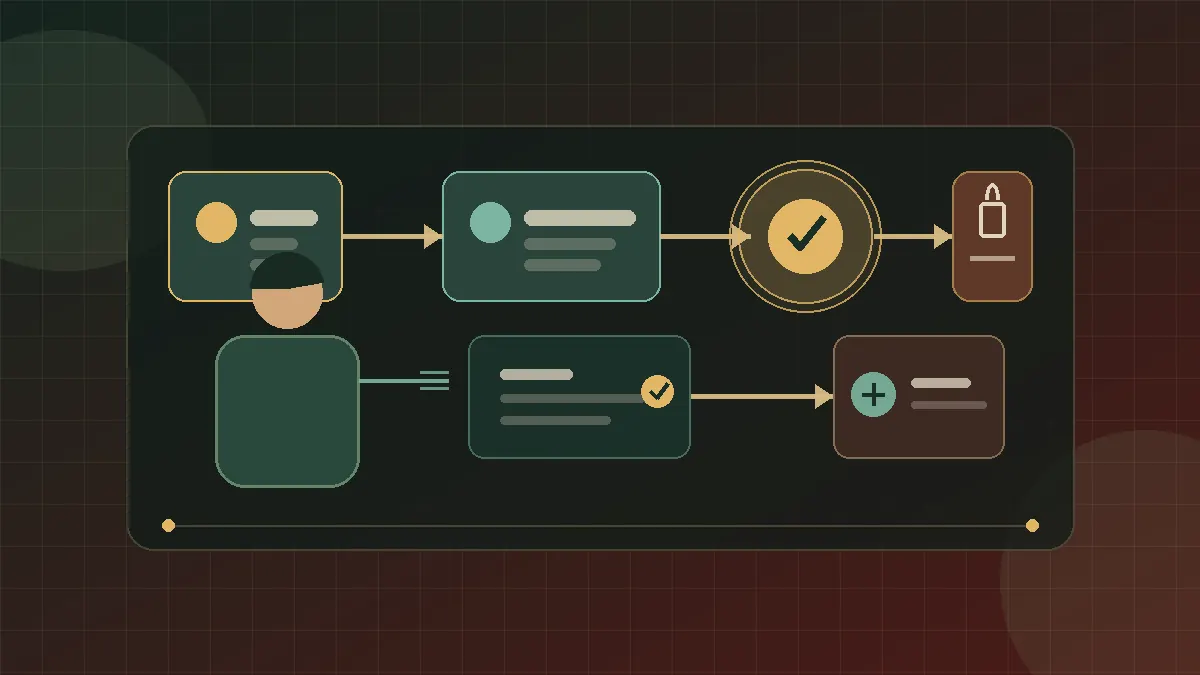
For a boutique consulting firm, the buying decision is not only whether the canvas feels easy. Check where the workflow runs, who holds connected credentials, which actions require approval, what the logs reveal, and what can be exported. A quick prototype may fit a hosted builder. Client data or write access can justify an open workflow builder on controlled infrastructure or a private cockpit. No-code is enough when the workflow stays understandable, testable, and removable.
What is a no-code AI agent builder?
A no-code AI agent builder replaces application code with visual steps, forms, prompts, and connections. Airtable describes the category as tools that let non-technical teams create AI-powered workflows without writing code (Airtable). The interface may look like a canvas: an event enters on one side, the agent evaluates it, tools perform permitted actions, and a result leaves on the other side.
The word "agent" matters. A fixed automation follows rules chosen in advance. An agent uses a model to handle a decision inside the boundaries supplied by its instructions and tools. OpenAI's practical guide uses the exact building blocks "model, tools, and instructions" (OpenAI). A useful builder should make those boundaries visible enough for an operator to answer a plain question: what can this agent read, decide, and change?
No-code does not mean no configuration. Someone still has to define the job, choose the connected tools, specify approval points, and inspect failed runs. It also does not settle the hosting decision. A visual workflow can run in a vendor account, in an open workflow builder on infrastructure you control, or inside a private cockpit. The canvas describes the work. The deployment model determines who controls its operating environment.
What can it automate?
A bounded starting workflow has a clear input and an observable output. These are illustrative workflow designs, not claims about a specific product.
- Prepare a client brief. Read approved source documents, draft a structured summary, and place it in a review queue. The human remains responsible for accepting the output.
- Triage an inbox. Classify incoming messages, suggest a reply, and route sensitive cases to a named person. Sending can remain behind an approval step.
- Maintain a project record. Extract agreed actions from meeting notes and propose updates to the project system. The workflow can require confirmation before writing.
- Assemble recurring reports. Pull permitted fields from connected systems, format a draft, and flag missing data for review.
- Research a prospect. Gather allowed public material, organize it against a fixed template, and save the result without contacting the prospect.
These jobs separate preparation from commitment. Drafting, classifying, and collecting can happen before the system sends a message or changes a client record. That separation is a design choice. n8n's product page describes visual workflows, connected tools, human approval steps, error handling, and inline logs as capabilities of its AI agent builder (n8n). Those capabilities provide useful questions for evaluating any builder, without making n8n the answer to every deployment.
Can you create your own AI agent for free?
This guide does not verify a current free offer. Verify current access terms on a provider's own page, and test export, controls, and exitability before using a builder for real work. n8n states that its projects can be exported to JSON for sharing, copying, or reuse (n8n). That documented artifact is one input to an exit test, not proof of a free offer or complete portability.
What is the best no-code AI agent builder for ownership?
There is no universal winner. I would choose the category that passes the firm's control and handover requirements: hosted no-code, an open workflow builder, or a private cockpit. The comparison below keeps those categories at parity and does not rank a product first.
Original buyer evaluation framework. These are control postures to verify with each provider or implementer. This is not a product ranking, and a product may support different postures.
| Decision point | Hosted no-code | Open workflow builder | Private cockpit |
|---|---|---|---|
| Operating environment | Provider-managed account | Deployment chosen by the firm | Dedicated environment controlled by the firm |
| Builder experience | Visual configuration | Visual configuration with an extension path | Visual operations inside a configured agent system |
| Credential custody | Verify where secrets are stored and who can administer them | Configure secret storage and administrator access | Keep custody within the firm's controlled environment |
| Approval design | Use the provider's available approval controls | Build approval steps into the workflow | Set approvals across workflows from the cockpit |
| Logs | Verify visibility, retention, and export | Configure logging and retention | Keep operational history within the controlled environment |
| Portability test | Export a real workflow and its supporting data | Inspect workflow files and dependencies | Test handover of workflows, data, and operating instructions |
| Operating responsibility | Provider operates the platform | Firm or technical partner operates the deployment | Firm or cockpit partner operates the dedicated system |
| Candidate use to evaluate | Bounded trial with acceptable provider dependency | Team that wants a visual builder plus deployment control | Firm that wants one owned operating layer for agent work |
This is a control spectrum, not a maturity ladder. A hosted builder can be a rational home for a low-impact experiment. An open workflow builder can suit a firm that has someone to operate it. A private cockpit can suit a firm that wants the environment to remain its own while a partner helps configure and maintain it. The right answer depends on the workflow's access, the firm's operating capacity, and the exit test it can actually pass.
For a deeper deployment comparison, read box versus SaaS for an AI workforce. To see the owned operating model, See the AI Jungle OS cockpit.
Which controls matter before you connect real work?
Use this original checklist during a live demo. Ask the seller or implementer to show each control on a test workflow. A policy page is not a substitute for seeing the relevant setting and its output.
- Access scope. List every mailbox, folder, database, and application the agent can reach. Grant only what the defined job needs. OWASP names Sensitive Information Disclosure as a risk category for LLM applications (OWASP).
- Action scope. Separate read, draft, write, send, delete, and purchase permissions. OWASP names Excessive Agency as a risk category when an LLM receives unchecked autonomy to act (OWASP).
- Approval points. Require a person to approve consequential actions. Verify what the approver sees, what can be edited, and whether a rejected action stops the run. n8n describes human-in-the-loop approval steps on its AI agent page (n8n).
- Instruction boundaries. Show the agent's standing instructions and the text supplied by external documents or messages. OWASP lists Prompt Injection as a named risk category (OWASP).
- Run history. Open a completed run and inspect inputs, tool calls, approvals, errors, and outputs. n8n describes inline logs and visual inspection of workflow steps as product capabilities (n8n).
- Dependency record. Identify every model, connector, external service, and data source needed by the workflow. OWASP includes Supply Chain Vulnerabilities among its named LLM application risk categories (OWASP).
- Stop control. Demonstrate how an operator disables the workflow, revokes its credentials, and prevents queued actions from continuing. Treat this as an acceptance requirement for your build.
The AI Jungle OS security model explains how these decisions fit into a private operating environment. The purpose of the checklist is not to promise zero risk. It is to make access and action boundaries inspectable before live client work enters the system.
When is no-code enough?
No-code is enough when the person responsible for the workflow can understand its path, reproduce a test, and change its boundaries without rebuilding the system. That judgment belongs to the firm. It should be based on a working demonstration, not a label on a product page.
A bounded intake flow is a good candidate when its states are visible and exceptions go to a person. A workflow becomes a poor no-code fit when important behavior is hidden inside opaque steps, when the required logic cannot be expressed clearly, or when maintenance depends on work the team cannot inspect. At that point, an extension written in code or a different deployment may be a workable operating choice.
The visual layer can still remain useful when one step needs code. n8n describes support for code alongside its visual workflow tooling and says projects can be exported to JSON (n8n). That is a product-specific example of an extension and export path, not proof that every open builder has the same capabilities.
The architecture also matters when several workflows share credentials or data. A builder canvas shows task logic, while the surrounding system governs identity, storage, approvals, and observation. AI agent architecture explains those layers and why the visible workflow is only part of the operating design.
What changes when data or credentials are sensitive?
Start by changing the design question. Do not ask only, "Can the agent complete this task?" Ask, "What is the smallest set of information and authority required to complete it?" Then configure the workflow around that answer.
Sensitive inputs raise the importance of data location, administrator access, retention settings, and logs. Credentials raise a separate issue because they authorize actions in another system. A workflow that drafts from a redacted document does not have the same authority as one that can send email or alter a client database. Treat each connection as a distinct permission decision.
The security vocabulary should remain precise. OWASP's LLM application project names Prompt Injection, Sensitive Information Disclosure, Supply Chain Vulnerabilities, and Excessive Agency as risk categories (OWASP). Those names do not determine your architecture. They give reviewers a shared way to ask whether untrusted input can affect instructions, whether outputs may expose protected information, whether dependencies are known, and whether the agent has more action authority than its job requires.
A private box changes custody, not the nature of the controls. The firm still needs scoped access, approvals, logs, and a stop procedure. Its advantage is that the deployment can be arranged around an environment the firm controls, instead of treating a provider account as the permanent home. The firm must also decide who operates that environment and how that responsibility is handed over.
Is an open-source no-code AI agent builder portable?
An open-source label does not prove portability. I would call a builder portable only after a representative workflow can be exported, its dependencies identified, and a copy operated with test data. n8n states that its projects can be exported to JSON for sharing, copying, or reuse (n8n). That is a product-specific artifact, not proof that every open builder can pass a full handover.
Exitability is the ability to leave a builder or implementation partner with the working materials needed to continue operating or rebuild the workflow. Treat this as an acceptance test written by the buyer. Do not settle for an "export available" checkbox.
Choose one representative workflow and export it. Inventory its prompts, instructions, connection definitions, schemas, stored data, approval rules, and run history. Do not export live secrets into an ordinary file. Instead, confirm that credentials can be revoked in the old environment and recreated under the firm's control in the new one.
Next, ask a person who did not build the workflow to read the export and explain the path. Have that person identify every external dependency and the operator steps needed after a failure. Then disable the original workflow and run the copy against test data. Record what is missing. The gaps are your actual switching dependency.
n8n states that its projects can be exported to JSON for sharing, copying, or reuse (n8n). That is a concrete product capability. Exitability still requires testing the workflow's dependencies and operating knowledge around that file. A portable diagram without credentials, data definitions, or handover instructions is not a working handoff.
FAQ
Do I need coding experience to use a no-code AI agent builder?
The category is designed around building workflows without writing code, according to Airtable's overview of no-code AI agent builders (Airtable). You still need to define the process, permissions, review points, and failure handling. A technical partner can configure the deployment while the firm retains control of the environment.
Is a no-code AI agent builder the same as workflow automation?
They overlap. A visual builder can contain fixed automation steps and an agent step that uses a model, tools, and instructions, the components identified in OpenAI's practical guide (OpenAI). The useful distinction is whether a step follows a predefined rule or asks a model to handle a bounded decision.
Should sensitive work always run on a private box?
There is no universal answer. Map the data, credentials, administrator access, action permissions, and operating responsibility, then choose a deployment that meets the firm's requirements. OWASP's named risk categories can help structure the review, but they do not prescribe a hosting model (OWASP).
What should I ask during a builder demo?
Ask the demonstrator to show access scope, a human approval, a failed run, a complete log, the stop control, and a real export. n8n's page provides product examples of approvals, error handling, visual logs, and JSON project export (n8n). Judge the product you are evaluating by what its own demo proves.
How do I avoid lock-in?
Run the exitability test before live deployment. Export a representative workflow, list its dependencies, rebuild credentials under separate control, and operate the copy with test data. Put the required handover materials and responsibilities into the project's acceptance criteria.
Choose a no-code AI agent builder your firm can inspect, constrain, operate, and leave under conditions you have tested. If the desired end state is a visual AI workforce on an environment that remains yours, See the AI Jungle OS cockpit.
Written by Tileo, who operates a portfolio of internet businesses on this same cockpit.