
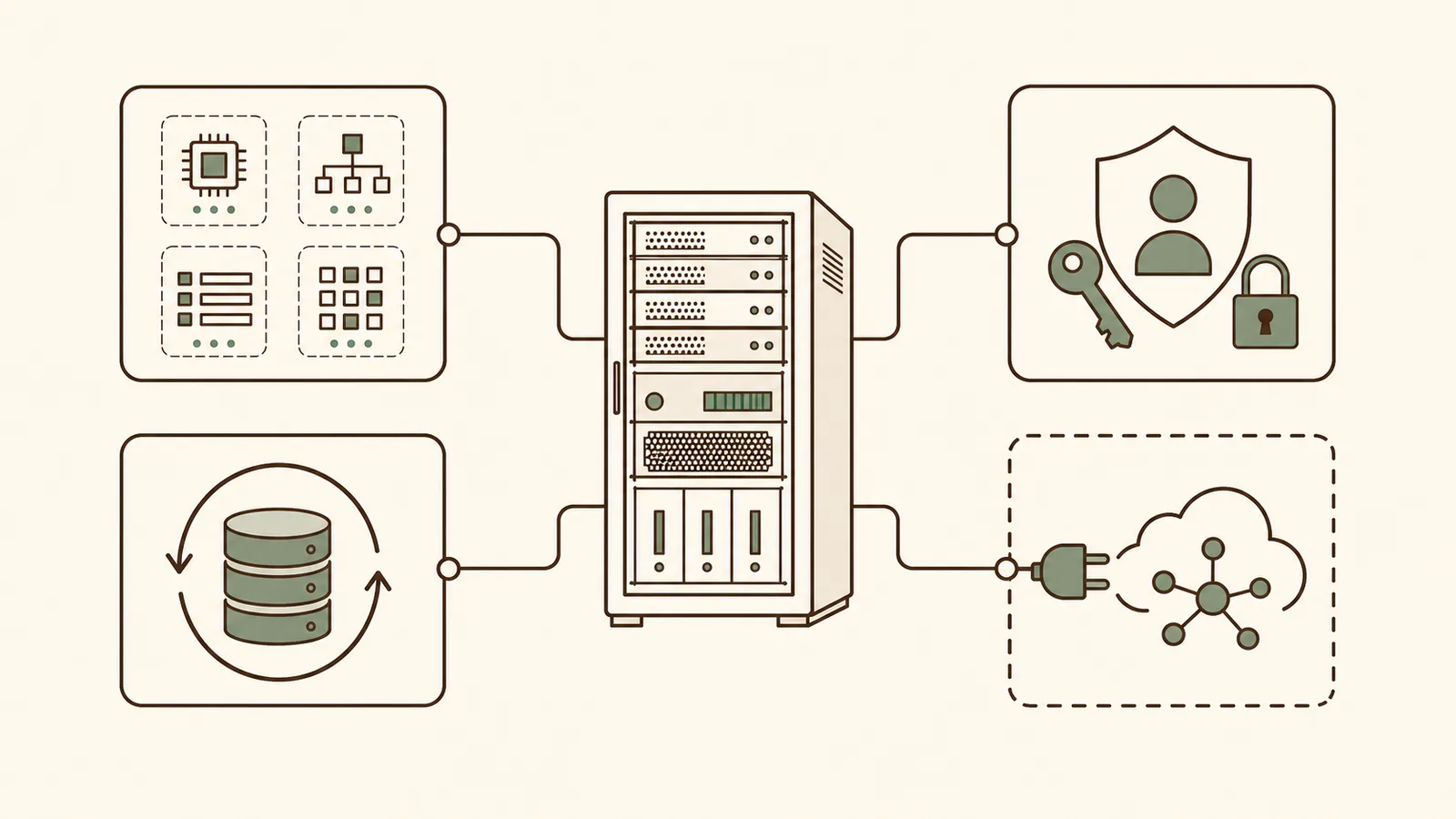
Can a small firm host its own AI server?
Yes, if the firm treats it as an operated business system rather than a box with a model on it. Start with one approved workload. Name the people allowed to use it. Name the operator who can change it. Then state which records may enter the system and where each processing step occurs.
“Self-hosted” should describe an operating boundary, not every dependency. Model execution can be local while an agent calls an external email, CRM, search, or model service. Those connected providers retain their own boundaries. The AI model hosting guide separates model execution from the wider application; compare the on-premise decision sheet for the wider boundary.
Operator callout: Our verdict is to self-host only when the firm can name the operator and the boundary it is taking back.
The practical test is simple. If nobody owns access, updates, backups, and recovery, the firm does not yet own an operable server. It owns an installation.
What must the firm own and operate?
The firm must assign ownership for the server, identities, data paths, changes, evidence, and recovery. That ownership can be performed internally or with attached support. It cannot remain implicit.
Create a one-page responsibility sheet:
- Name the workload owner who accepts what the system is meant to do.
- Name the server operator who controls access, configuration changes, updates, backups, and recovery.
- List each local model, external model API, and connector as a separate boundary.
- Record which identities can request work and which identities can approve actions.
- Decide which action records the firm needs to inspect after a run.
- Assign who can stop the service and who can restore it.
The software-layer ownership guide helps separate code access from operating responsibility.
Which deployment boundary fits the workload?
Choose the boundary from the workload, access pattern, and external dependencies. Do not select a machine first and invent its purpose afterward.
| Boundary | Good decision signal | Operator responsibility | Boundary to state |
|---|---|---|---|
| Local workstation | One operator is proving an intentionally local workload | That operator owns the machine, access, changes, backups, and recovery | Local model execution does not cover any external connector; Ollama separately describes local operation and cloud-hosted model processing (Ollama FAQ) |
| Firm-operated server | Approved firm users need a private box under named firm operation | The firm owns identities, exposure, updates, evidence, backups, and recovery | |
| Dedicated hosted instance | The private instance sits outside the office but remains under a named operating model | The firm must divide host-side and firm-side duties explicitly | |
| Hybrid routing | Some work is local while selected models or connectors are external | The operator owns the routing decision and the record of each boundary | Cloud-hosted Ollama models process prompts and responses to provide that service, unlike its stated local-operation boundary (Ollama FAQ) |
No row is a universal winner. A documented Tailscale implementation combines Proxmox, NixOS, Docker, NVIDIA drivers, Ollama, Open WebUI, and Tailscale. It is one implementation, not a required architecture (Tailscale engineering guide).
Boundary callout: A private server can still have external data paths. Draw them before approving the pilot.
What hardware should be decided before software?
Decide whether the intended model and workload fit the machine before choosing the surrounding software stack. Write down the model size, expected concurrency, context demand, latency tolerance, memory fit, and expansion path. Keep these as workload decisions. Do not turn them into invented universal minimums.
Use this hardware decision list:
- Workload: define the exact task that the pilot must accept and return.
- Model size: identify the model build that will actually be evaluated.
- Concurrency: state how many approved requests the acceptance test will submit together.
- Context: define the documents or conversation state supplied to the model.
- Latency tolerance: set the response condition that the firm will accept for that workload.
- Memory fit: inspect the chosen model while it is loaded. Ollama says
ollama psshows whether it is in GPU memory, system memory, or split across CPU and GPU (Ollama FAQ). - Expansion: decide whether the pilot machine is the intended operating machine or a disposable test boundary.
If GPU passthrough is part of the design, validate compatibility rather than assume it. Tailscale’s documented stack says compatible hardware is required, including suitable BIOS and CPU support (Tailscale engineering guide). Ollama documents GPU acceleration in Docker on Linux or Windows with WSL2 when NVIDIA Container Toolkit is present, while Docker Desktop on macOS does not expose GPU acceleration through passthrough or emulation (Ollama FAQ).
How should network access and data paths be mapped?
Map every listener, user path, model call, connector, credential, record, and approval step. The diagram can be plain. It must show what stays on the box and what leaves it.
Start from the default state. Ollama binds to 127.0.0.1 on port 11434 by default, and its bind address can be changed with OLLAMA_HOST (Ollama FAQ). A change from loopback access is therefore an operating decision. Record who needs the new path and who can alter it.
For remote access, document the chosen design as a specific implementation. Tailscale’s guide demonstrates access inside a tailnet and uses Tailscale Serve with TLS; it does not establish a universal required network pattern (Tailscale engineering guide). The private AI boundary guide can be used to review data, identity, and log boundaries.
Data-path callout: “Runs locally” answers where one component executes. It does not answer where every prompt, file, credential, action, or log goes.
What support and maintenance does a self-hosted AI server need?
Launch starts the operating queue. It does not close it. The named operator needs a visible checklist tied to the actual system boundary.
Operator checklist:
- Review approved users and scoped credentials against the responsibility sheet.
- Review each local model, external model endpoint, and connector against the data-path map.
- Approve and record configuration, software, model, and network changes before they enter the operating boundary.
- Confirm that required action records can be inspected.
- Run the defined backup check against the records and configuration the firm decided to retain.
- Run the defined recovery acceptance check and record who authorized the return to service.
- Recheck the stop authority, restoration authority, and support handoff after an ownership change.
This list is not a compliance claim. It is an operator queue. The firm should connect each item to a named owner and acceptance evidence.
Is self-hosting actually free?
No operating plan should treat self-hosting as free. Open software can remove a software license line without removing the resources needed to operate the system.
Keep the cost record separated into:
- Hardware acquisition and any expansion chosen for the accepted workload.
- Power used by the firm-operated machine.
- Operator time for access, changes, updates, evidence, backups, and recovery.
- Backup capacity and the process chosen to test restoration.
- Replacement capacity required by the firm’s recovery decision.
- External model, connector, hosting, or support services that remain in the design.
Do not hide external processing inside the word “self-hosted.” Ollama says its cloud-hosted models process prompts and responses to provide the service, while its local operation does not send prompts or data back to ollama.com (Ollama FAQ).
How should a firm run a pilot?
A pilot should end with accepted evidence for one bounded workload, not a general feeling that the stack works. Define the pass conditions before installing the model or opening network access.
Bounded acceptance checklist:
- The workload has an owner, an allowed input set, an expected output, and a stop condition.
- The chosen model and its execution boundary are recorded separately from every external model and connector.
- Approved identities can reach only the access path defined for the pilot.
- Credentials are scoped to the actions approved for the workload.
- The approval queue blocks the actions the firm chose to review before execution.
- Required action records can be inspected after the acceptance run.
- The selected model is checked on the intended hardware. With Ollama,
ollama psreports GPU, system-memory, or split loading (Ollama FAQ). - The defined backup is checked and the defined recovery result is accepted by the named owner.
- External paths observed in the run match the approved data-path map.
- The owner records a decision to stop, revise, or move the workload into operation.
Pilot callout: Reject an ambiguous pass. Record the unmet condition and keep the workload outside the operating boundary.
What else do firms ask about a self-hosted AI server?
How much does it cost to build an AI server?
There is no responsible single figure without a workload and boundary. Build the decision from hardware, power, operator time, backups, replacement capacity, and external services.
How do you make your own self-hosted AI?
Start with a bounded workload, then choose the model boundary, hardware, identities, network path, records, and recovery owner. A documented implementation may help, but it is not a universal blueprint. Tailscale’s example uses Proxmox, NixOS, Docker, NVIDIA drivers, Ollama, Open WebUI, and Tailscale (Tailscale engineering guide).
Do you have to pay for self-hosted AI?
The operating plan still has resource lines even when selected software is available without a license fee. Record hardware, power, operator work, backups, replacement capacity, and any external services. Do not describe local operation and cloud-hosted model processing as the same boundary (Ollama FAQ).
Can I build an AI on my own?
One operator can run a bounded local pilot, but the workload still needs access, change, backup, and recovery decisions. If the design adds cloud-hosted models, prompts and responses are processed to provide that service under Ollama’s stated cloud boundary (Ollama FAQ).
What is the difference between self-hosted AI and ChatGPT?
The useful comparison is the processing and operating boundary, not the label. State where the selected model runs, which external services receive data, and who operates access and recovery. Ollama itself distinguishes local operation from its cloud-hosted model service (Ollama FAQ).
The decision is ready when the firm can point to a workload, a boundary map, an operator, and acceptance evidence.
Written by Loïc Guyon (Tileo), who runs the AI Jungle fleet.